Regional Development Director


Smart specialisation is an EU regional innovation policy approach aiming to help regions identify the most promising areas for their future development, and using this information to improve the allocation of cohesion policy funds. A smart specialisation strategy (S3) in the EU context comprises a national or regional innovation strategy, setting priorities for research and innovation spending.
The European Commission first introduced the smart specialisation concept for the 2014-2020 programming period. Producing a strategy was made a condition2 to be able to access ERDF R&I funding.
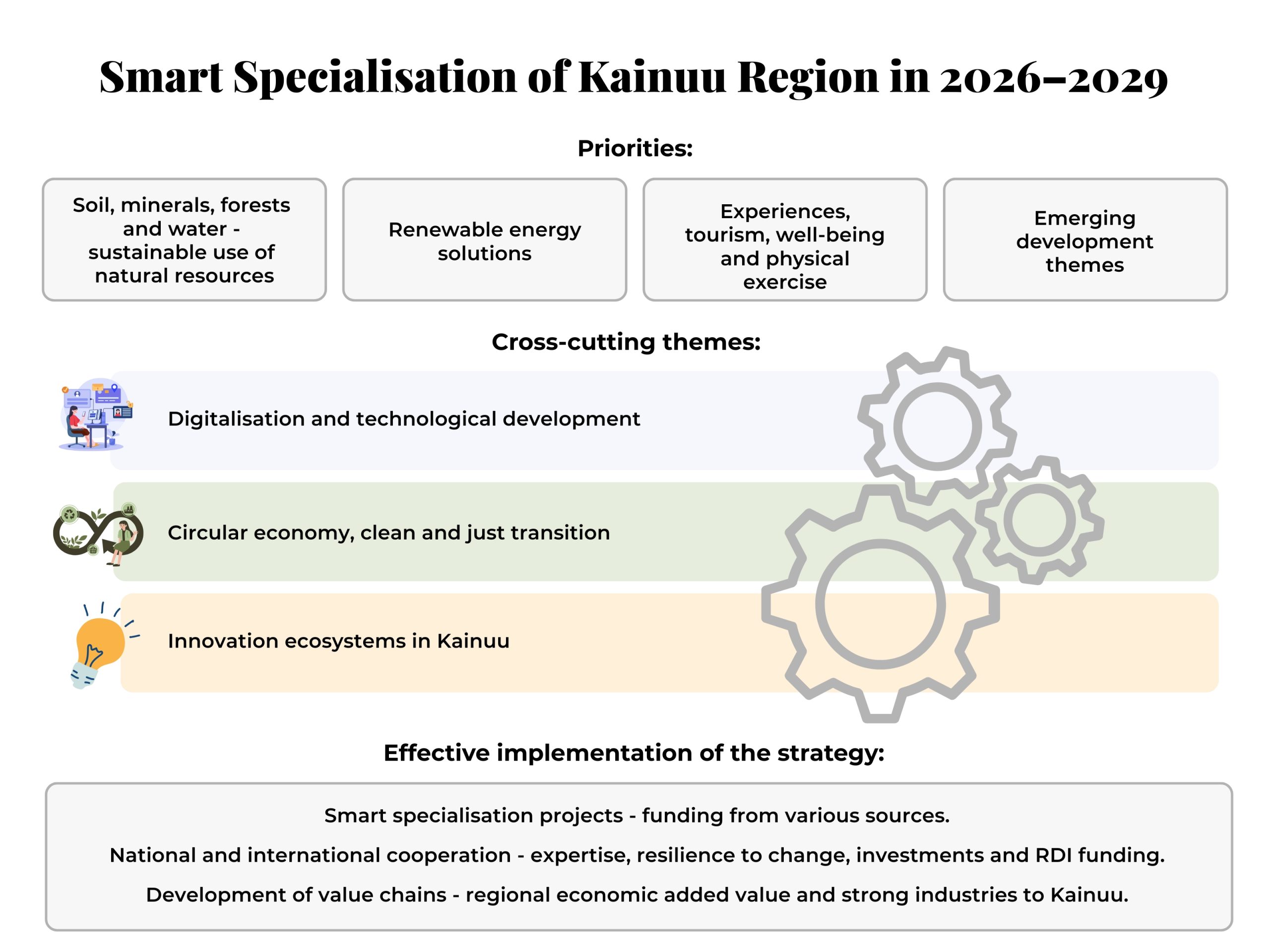
The Smart specialization choices for Kainuu region were updated as a part of the renewal process of the regional plan and regional programme, and are described in a chapter of the Regional programme 2026 – 2029.
The regional councils of Eastern and Northern Finland have prepared a joint smart specialisation strategy for the regions of Eastern and Northern Finland. It has been implemented as of 1 January 2024. The aim of the joint strategy is to create a common framework for the regions to promote the competence and development covered by the strategy. This does not remove the responsibility of the regional councils for promoting the smart specialisation of their own region, but rather supports the implementation of the regional strategies. The joint smart specialisation strategy enables cross-regional cooperation and, if necessary, the preparation of joint projects and funding applications between the regions.

BERRY+ is a Smart Specialisation and industrial modernisation partnership, bringing together eight regions from six European member states. BERRY+ is dealing with the processing of renewable natural resources, ingredients and side flows towards high added value products.
BERRY+ is mostly a research and development as well as design, development and testing initiative. Prioritised types of industrial domains include, but are not restricted to, functional foods and associated technologies, vegetable-based proteins and associated technologies, herbs applications, medical applications and technologies, regenerative cosmetics, forest-economy side flows applications and technologies.
A primary diversification base has been identified, bringing together the economic and research bases of the BERRY+ regions. This exercise resulted in a wide range of potential value chain collaborations: renewable natural resources (cultivated & wild berries, grapes, apples, forest fruits, cereals, dairy, herbs, forest industry side flows); research & research applications (e.g. anti-microbial compounds replacing synthetic preservatives, bio-processing of berries by enzymes and fermentation, scaling up to bio reactors and downstream processing, measurement technology, functional foods). Value chains we plan to investigate & specify for project and investment initiatives include (i) food processing value chains (functional foods, vegetable- or dairy-based proteins, herbs applications,…), (ii) regenerative cosmetics and (iii) forest-industries sideflow-based products replacing current, non-sustainable and non-renewable products (such as plastics) and raw materials (oil, chemicals etc.) in various industries.
BERRY+ partnership has two key objectives:
The BERRY+ implementation is organised into three main themes or components:
Regional Council of Kainuu, Finland (NUTS3: FI1D4)
Helsinki – Uusimaa Regional Council, Finland (NUTS2: FI1B. and NUTS3: FI1B1)
Region of Western Greece, Greece (NUTS2: EL63)
Regional of Western Macedonia, Greece (NUTS2: EL53)
Region of Friuli Venezia Giulia, Italy (NUTS2: ITH4)
Lombardy Region, Italy (NUTS2: ITC4)
Centro Region, Portugal (NUTS2: PT16)
ACCIO on behalf of the Region of Catalonia, Spain (NUTS2: ES51)
The original idea for planning the BERRY+ partnership came up in the framework of the Interreg Europe project BRIDGES (implementation period 1.4.2016 – 31.3.2021). The main partner of the project was Kainuun Etu Oy and in the last months, after the end of Kainuun Etu Oy’ s operations, the Regional Council of Kainuu.
The BERRY+ S3 partnership implements Action 2 of the Kainuu region BRIDGES action plan. It builds on the BRIDGES project experience from inter-regional collaborative schemes based on RIS3 complementarities and the corresponding research, knowledge and economic bases of the participating regions. The partnership application was prepared together and in November 2020, the Joint Research Centre (JRC) of the European Commission approved the European Commission approved the proposal to establish an international BERRY + cluster.
Last updated on: 22.01.2026